How to Save Money While Traveling: 14 Tips I Actually Use

Traveling doesn’t have to cost a fortune. I’ve traveled around the United States in a lot of different ways over the years. I’ve flown on budget airlines, taken road trips across the country, traveled cross-country on Amtrak, stayed with friends, used public transportation, and planned trips around sporting events.
One thing I’ve learned is that you don’t have to travel luxuriously to have a great trip.
I’d rather save $150 on a flight or hotel and use some of that money for food, a baseball game, or another experience. Better yet, sometimes the money I save makes it possible to take another trip later.
If you’re trying to travel without blowing your budget, here are 14 ways to save money while traveling that I’ve actually used or would consider using myself.

1. Use Google Flights Before Booking a Flight
One of the first things I do when researching airfare is compare my options.
Google Flights makes this much easier because you can see prices from multiple airlines and adjust your dates to see whether flying a day earlier or later could save you money.
If your travel schedule is flexible, don’t automatically search for one exact set of dates.
Check the date grid and price graph. Sometimes moving your trip by a day or two can make a noticeable difference in airfare.
You can also track prices instead of immediately booking. Google Flights allows you to track a route for specific dates or even “Any dates” if your plans are flexible. Google will then notify you when prices change significantly.
I’ve used Google Flights when planning trips because I want to know what the normal price range looks like before I spend my money.
If you’ve never used all of its features, check out my How to Use Google Flights guide.
My tip: Don’t just look at the cheapest flight. Pay attention to departure times, layovers, airports, and baggage fees too. Saving $30 isn’t worth it to me if it turns a two-hour flight into an eight-hour travel day.

2. Be Flexible With Your Travel Dates
Flexibility can save you a lot of money.
Friday afternoon might be the perfect time for you to leave, but it may not be the cheapest. Before booking, I like to check what happens if I move the departure or return date.
Google Flights makes this especially easy because its date grid and price graph show how airfare changes across different travel dates.
This applies to hotels too.
If you’re going somewhere for a major sporting event, festival, convention, or holiday weekend, hotel rates can shoot up. Sometimes arriving a day earlier, leaving a day later, or staying slightly outside the main tourist area can make the trip cheaper.
You don’t have to rearrange your entire vacation to save $10. I’m talking about looking for meaningful differences.
If leaving Thursday instead of Friday saves me $100, I’m going to consider Thursday.
3. Don’t Be Afraid of Budget Airlines
I’ve saved money several times by flying budget airlines.
Years ago, I flew Frontier from Atlanta to Cincinnati for $193 round trip. At the time, comparable flights on some of the larger airlines would have cost me more than $300.
That difference matters.
If I save $100 on airfare, that’s money I can use for my hotel, meals, transportation, or whatever event I’m traveling to see.
Budget airlines aren’t perfect, though.
The cheap advertised fare isn’t necessarily what you’ll ultimately pay. You need to look at baggage charges, seat selection, and other fees before deciding whether it’s actually cheaper.
If you’re considering Frontier, I’ve written about the pros and cons of flying Frontier Airlines based on my experience.
Sometimes I’ll pay more for a traditional airline if the schedule or overall experience is significantly better. Other times, especially for a short flight, the budget airline makes more sense.
Do the math instead of choosing an airline based solely on the first price you see.
4. Pack Light and Watch Baggage Fees
This goes directly with using budget airlines.
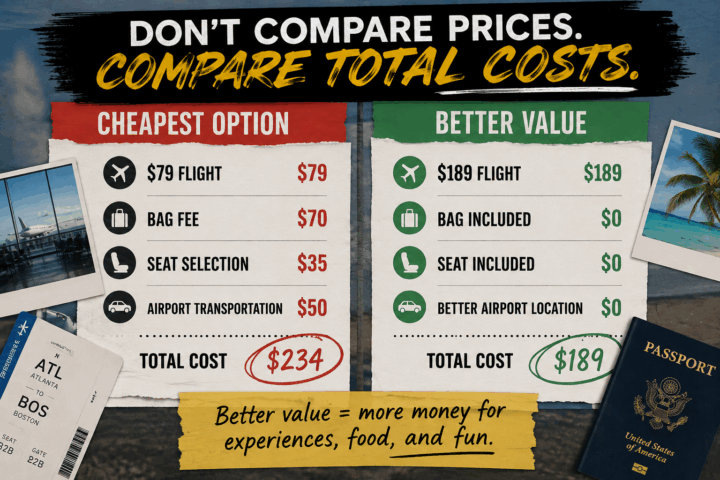
That $59 flight doesn’t look quite as cheap after adding a checked bag, carry-on, seat assignment, and other charges.
Whenever possible, pack strategically.
For shorter trips, ask yourself whether you really need a checked suitcase. Depending on the airline, staying within the personal-item or carry-on allowance could save money in both directions.
Airline baggage rules and fees vary, so check your airline’s current restrictions before leaving for the airport.
I also recommend checking those rules before you buy the ticket, not after.
If Airline A charges $170 for the flight with the bags you need while Airline B charges $190 with your baggage included, Airline B may actually be the better deal.
The total trip cost matters more than the headline fare.
5. Compare Hotels Instead of Automatically Booking the First One
Hotels can eat up a huge part of a travel budget.
I don’t automatically book the first property that looks good.
Compare several booking sites and look at the final price, not just the nightly rate. Taxes and other charges can change what initially looked like the cheapest option.
Location matters too.
A cheaper hotel isn’t always cheaper if it’s so far away that you’re spending another $40 or $50 per day getting back and forth.
If I’m traveling for a baseball game or another sporting event, I’ll compare hotels around the stadium with hotels near public transportation.
Sometimes paying slightly more for a better location saves money elsewhere.

6. Stay With Friends or Family When It Makes Sense
This one has saved me a lot of money over the years.
When I started my MLB stadium challenge in 2008, I flew to New York to see a game at the original Yankee Stadium. Instead of paying for a New York hotel, I stayed with a friend in Brooklyn.
That immediately removed one of the biggest expenses from the trip.
Obviously, you don’t want to invite yourself to somebody’s house every time you travel. But if you have friends or family in a city and they’ve offered you a place to stay, don’t automatically dismiss it because you think you need a hotel experience.
I’ve always cared more about what I’m doing outside the hotel room anyway.
If I can stay somewhere safe and comfortable for free and spend that hotel money experiencing the city, that’s a win.
7. Use Public Transportation
You don’t need a rental car in every city.
I’ve visited places where having a car would have actually made the trip more annoying because I’d have to deal with parking, traffic, and additional fees.
Cities such as New York, Chicago, Boston, and Washington, DC, have public transportation systems that can get you to many of the places tourists want to visit.
I used New York’s subway during the trip that started my MLB stadium challenge. I’ve also used transit during plenty of other city trips.
Before renting a car, calculate what you’re really paying:
- Rental rate
- Taxes and fees
- Gas
- Hotel parking
- Parking at attractions
- Stadium parking
- Tolls
Then compare that with public transportation and occasional Uber or Lyft rides.
Depending on the destination, you could save hundreds of dollars.
8. Compare Uber, Lyft, Public Transit, and Rental Cars
I don’t use the same transportation strategy in every city.
Sometimes public transportation is the obvious choice. Sometimes Uber or Lyft makes more sense. Other trips genuinely require a rental car.
Compare your options.
For example, if I’m only taking two rides in a day, paying for Uber or Lyft might be cheaper than renting a car and paying $40 to park it overnight.
On the other hand, if I’m taking a road trip outside the city and visiting several places, a rental car may be the better option.
I also compare Uber and Lyft before requesting a ride. The prices can be different for the exact same trip.
Don’t get into the habit of automatically opening one app every time.
A few dollars saved here and there over a four-day trip adds up.
9. Take a Road Trip When Flying Doesn’t Make Sense
Flying isn’t automatically the cheapest way to travel.
I’ve taken multiple road trips, including an Interstate 10 cross-country road trip, and driving gave me the opportunity to see multiple cities and attractions during one journey.
For trips within a reasonable distance, calculate the cost of driving before buying a plane ticket.
Consider:
- Gas
- Tolls
- Parking
- Hotel stops
- Wear on your vehicle
Then compare that with airfare, airport transportation, baggage fees, and a rental car at your destination.
Road trips become especially attractive when multiple people are traveling together because you’re splitting transportation costs instead of buying several airline tickets.
They also give you more flexibility. If I see something interesting along the way, I can stop.
That’s part of the experience.
10. Consider Train Travel for the Right Trip
In 2024, I did something completely different.
Instead of driving across the country again, I took an Amtrak trip across America.
My route took me from Atlanta to Seattle and eventually across the country to Boston. Along the way, I attended Mariners, Twins, and Red Sox games as part of my MLB stadium challenge.
Train travel isn’t always cheaper than flying, so I wouldn’t tell you to blindly book Amtrak because you’re trying to save money.
But it can provide value when you look at the entire experience.
You’re combining transportation with sightseeing, and on certain routes you may avoid some of the costs associated with renting a car or taking multiple flights.
The key is the same as everything else on this list:
Compare your options before you book.
Sometimes the plane wins.
Sometimes driving wins.
Sometimes taking the train across the country becomes one of the most memorable trips you’ve ever taken.
11. Look for Free Things to Do
You don’t have to pay admission everywhere you go.
Some of my favorite cities have plenty of things you can experience without spending much money.
Washington, DC, is probably one of the best examples. Most Smithsonian museums are free, and you can spend a huge portion of your trip visiting museums, monuments, and other attractions without paying admission.
I’ve also found inexpensive or free things to do in places like New York, Chicago, and Atlanta.
Before your trip, search for:
- Free museums
- Parks
- Beaches
- Historic neighborhoods
- Walking trails
- Free festivals
- Public art
- Markets
- Free observation areas
- Self-guided walking tours
You don’t need to fill every hour of your vacation with a paid attraction.
If you’re headed to New York, check out my guide to cheap things to do in NYC. My Washington, DC guide also includes several attractions that won’t cost you anything.
Saving $30 or $40 on an attraction gives you more money for something else you really want to do.
12. Watch Out for Major Events When Choosing Your Dates
This is something people don’t always think about.
You could find a cheap flight and still end up with an expensive trip because you picked one of the worst weekends possible for hotel prices.
Major sporting events, festivals, conventions, graduations, and concerts can increase demand for hotels and transportation.
I’ve traveled specifically for sporting events plenty of times, so sometimes paying those prices is unavoidable. If the whole purpose of my trip is to see a particular game, I can’t move the game to Tuesday because the hotel is cheaper.
What I can do is plan early and compare my options.
For example, I may:
- Stay farther from the stadium but near public transportation.
- Arrive before the biggest crowds.
- Compare several hotel sites.
- Look at nearby neighborhoods instead of only downtown.
- Book refundable accommodations early and continue watching prices.
If the event isn’t why you’re visiting, check the city’s event calendar before choosing your dates.
There’s no reason to accidentally pay championship-weekend hotel prices when you don’t even care about the championship.
If you’re intentionally traveling for a game, my Sports Events Travel Hub has resources for comparing tickets, flights, hotels, and transportation.
13. Compare Sports and Event Ticket Prices
Sports are a big part of my travel.
My goal to visit MLB stadiums has taken me to cities all over the country, and I’ve also traveled for other major sporting events.
One lesson I’ve learned is that ticket prices can vary a lot. Don’t assume the first ticket marketplace you check has the best deal.
Compare your options and pay attention to the final price, including fees.
Also think about how important the seat actually is to you.
Sometimes I want a great seat. Other times, I just want to get inside the stadium and experience the atmosphere. If that’s the goal, I don’t need to spend hundreds of dollars to sit close to the field.
My MLB stadium journey actually started at the original Yankee Stadium in 2008 without me having a ticket beforehand. I showed up about 10 minutes before the game and managed to get the last bleacher ticket at the box office.
I wouldn’t recommend making that your normal ticket-buying strategy. LOL.
These days, I’d rather compare prices beforehand.
14. Use Cashback, Rewards, and Points When They Actually Save You Money
I’m all for getting something back on money I was already going to spend.
Over the years, I’ve used cashback sites and rewards programs when booking travel. I’ve also used travel rewards and points when they made sense.
But there’s an important distinction:
Don’t spend more just because you’re earning points or cashback.
If Hotel A costs $500 and gives you $15 cashback while Hotel B costs $450 with no cashback, Hotel B is still the better deal.
The same goes for credit card rewards.
Points and miles can reduce the cost of flights and hotels, but they only help if you’re using credit responsibly. Paying interest because you carried a balance can wipe out the value of whatever points you earned.
I look at rewards as an extra discount, not a reason to make a purchase.
Compare the actual price first.
Then see whether cashback, points, miles, or another reward can make the deal even better.
How I Decide Whether a Travel Deal Is Actually Good
One of the biggest lessons I’ve learned from traveling is that the cheapest individual price doesn’t necessarily create the cheapest trip.
A $79 flight isn’t a bargain if I have to pay another $120 for bags and $80 getting to an inconvenient airport.
A $100 hotel isn’t a bargain if I spend $60 per day getting downtown.
And a cheap game ticket isn’t necessarily cheap if the fees double the price.
I try to look at the total cost of the trip:
Transportation + lodging + food + activities + local transportation + fees
That’s the number that matters.
Before booking, I compare a few different versions of the trip and see which one gives me the best combination of price and experience.
I’m not always looking for the absolute cheapest trip.
I’m looking for good value.
Plan Your Trip and Compare Prices
Before booking your next trip, compare the major expenses instead of buying everything from the first site you visit.
Flights: Start with Google Flights to compare dates and routes.
Hotels: Compare hotel prices across multiple booking sites and pay attention to the final price and location.
Event Tickets: Compare marketplaces before buying tickets to games, concerts, or other events.
Transportation: Compare public transit, Uber, Lyft, and rental cars based on what you’ll actually need at the destination.
Frequently Asked Questions About Saving Money While Traveling
What is the easiest way to save money while traveling?
Start with your biggest expenses.
Saving $100 on airfare or $150 on a hotel will usually make a bigger difference than worrying about saving $2 on a cup of coffee.
I focus first on flights, accommodations, and transportation. Then I look for smaller savings on food and activities.
Is it cheaper to book flights early?
Not always.
Flight prices constantly change based on the route, dates, demand, and other factors. Instead of relying on a rule that says you should always book a certain number of days before traveling, I prefer to research prices and use tools like Google Flights to track them.
That gives me a better idea of whether the fare I’m seeing is actually good.
How can I save money on hotels?
Compare multiple booking sites, consider staying outside the most expensive tourist areas, and look for hotels near public transportation.
Also look at what’s included.
A hotel that costs slightly more but includes breakfast, free parking, or another useful perk could ultimately cost less.
How can I eat cheaply while traveling?
You don’t have to avoid restaurants.
Eat the hotel breakfast if it’s included, buy snacks and drinks from grocery stores, research affordable restaurants before you get hungry, and decide which meals you actually want to splurge on.
That’s how I prefer to do it.
Can you travel without spending a lot of money?
Absolutely.
You still need money to travel, but you have control over many of the costs.
Being flexible with your dates, comparing flights and hotels, using public transportation, finding free attractions, and planning ahead can make a significant difference.
I’ve traveled by plane, car, train, and public transportation. I’ve taken cross-country trips, traveled for baseball games, visited expensive cities, and found ways to make those trips work without needing luxury accommodations or first-class flights.
That’s really what saving money while traveling means to me.
I’m not trying to have the cheapest vacation imaginable.
I want to spend less on the things that don’t matter as much to me so I have money for the experiences that do.
Sometimes that means taking a Frontier flight instead of Delta. Sometimes it means riding the subway instead of getting an Uber. Sometimes it’s staying with a friend instead of paying for a hotel.
And sometimes I’ll gladly spend more because there’s something I really want to experience.
The goal is to be intentional with your money.
Save where you can, spend where it matters, and enjoy the trip.
Like My Money Chronicles? Add us as a Preferred Source on Google to see more of our content in your search results.